

How to Compare Deer Velvet Supplement Ingredients
Last Updated: November 1, 2026
Quick Summary
To learn how to compare deer velvet supplement ingredients, start with the Supplement Facts panel and compare velvet amount per serving, not per capsule, then check whether the velvet is an extract or powder and look for an extract ratio such as 75:1. Confirm the species and country of origin are named, and verify testing through a certificate of analysis with numerical results.
- Compare products on the serving size, never the capsule, since two capsules can double the velvet amount.
- A label listing velvet weight without an extract ratio or marker compound tells you very little about potency.
- Match the potency measurement type before comparing numbers, because a 75:1 extract ratio cannot be fairly compared to raw milligrams.
- A certificate of analysis with no batch number, lab name, or numerical results is decoration, not verification.
- Score each product 1 to 5 on seven criteria and total the column to build a side-by-side worksheet.
Table of Contents
- Start With the Supplement Facts Panel
- What Counts as an Active Ingredient in Deer Velvet
- Deer vs Elk Antler Velvet: Does Species Change the Label
- Deer Velvet Supplement Testing and Contaminant Checks
- Deer Velvet vs Colostrum Supplements: Reading Two Labels Side by Side
- Build Your Own Side-by-Side Comparison Worksheet
- Frequently Asked Questions
Start With the Supplement Facts Panel
Learning how to compare deer velvet supplement ingredients starts with one document: the Supplement Facts panel.
At NZVel, we read a lot of deer velvet labels, and the pattern is consistent. Products that look identical on the shelf can differ enormously once you turn the bottle around. The panel shows serving size, ingredient amounts, and how the velvet was processed.
Here is the sequence we use:
- Find the serving size and servings per container.
- Note the velvet amount per serving, not per capsule.
- Check whether the velvet is listed as an extract or a powder.
- Look for an extract ratio, such as 75:1.
- Scan the "other ingredients" list for fillers.
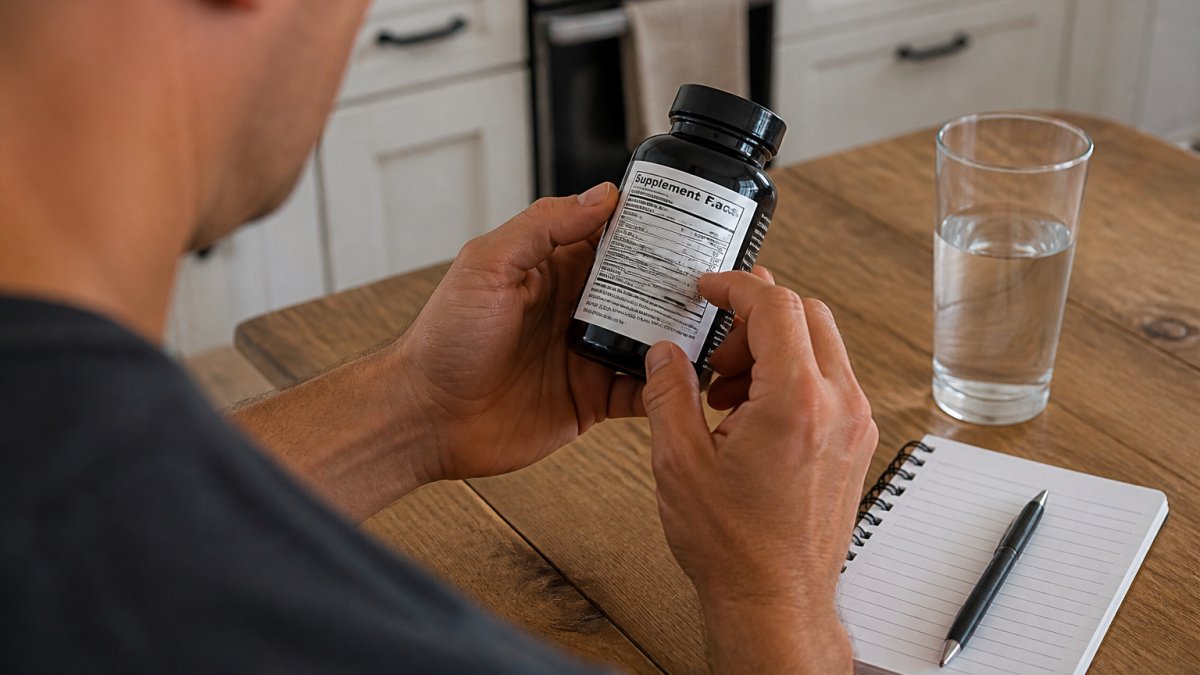
Serving Size, Ingredient Amounts and Standardization
Serving size is where most comparisons go wrong. A bottle might say 500mg per capsule, but if the label recommends two capsules per serving, the real amount is 1,000mg. Compare products on the serving, never the capsule.
Standardization matters just as much. A standardized extract states a marker compound and a consistent level of it, so batch to batch you get the same thing. A non-standardized powder gives you whatever the raw material happened to contain.
Watch out: a label that lists velvet weight but no extract ratio or marker compound is telling you very little. You cannot compare potency if potency was never declared.
What Counts as an Active Ingredient in Deer Velvet
Active ingredients in deer velvet are the natural compounds the tissue contains, including growth factors and minerals.
The distinction matters because some products list a long ingredient deck while delivering very little velvet. Others list velvet alone and let the compound profile speak for itself. Both approaches can be honest, but you need to know which one you are reading.
Growth Factors, IGF-1, Amino Acids and Minerals
Growth factors are natural proteins that stimulate cell growth in the body. IGF-1 is the most well known growth factor.
A common mistake is treating IGF-1 as the whole story. Growth factors work as a matrix, and a product that isolates one compound may not behave the same way as one that preserves the full range. Our IGF Athlete Formula tablets list a declared IGF-1 level alongside the full growth matrix.

Beyond growth factors, look for amino acids, collagen, and minerals. These are the supporting cast, and their presence is a reasonable sign that the velvet was processed gently rather than stripped down.
Deer vs Elk Antler Velvet: Does Species Change the Label
Species changes the label in one specific way: it changes what the product is allowed to claim about its source.
First, confirm the species is named. "Antler velvet" alone is not enough. Look for "Cervus elaphus" (red deer), "Cervus canadensis" (elk), or a plain-language species name.
Second, check the country of origin and the harvesting framework. A label that names the country is easier to verify than one that says only "imported."
Third, compare how potency is declared. Standardizing these measurements ensures that you are not misled by varying concentrations, a principle that remains equally vital when you check herbal ingredients for consistency across different supplement types.
Fourth, look at the processing method. Freeze-drying, low-heat drying, and solvent extraction preserve different compound profiles, so a label that states the method gives you a basis for comparison.
Species also affects positioning.
Pure Deer Antler Velvet - 120 Capsules →
Deer Velvet Supplement Testing and Contaminant Checks
Deer velvet supplement testing is the step most buyers skip, and it separates a serious product from a cheap one. Velvet is a raw animal tissue, so contaminant control is not optional. But "third-party tested" on a label can mean almost anything, so read the evidence rather than the badge.
Start with the certificate of analysis (COA).
Ask what the COA actually covers. For deer velvet, the meaningful tests fall into four groups:
- Identity testing, confirms the material is actually deer antler velvet and not a substitute or dilution. Look for a named method such as microscopy, DNA barcoding, or chromatographic fingerprinting.
- Heavy metals, lead, arsenic, cadmium, and mercury are the standard panel for animal-derived ingredients. A COA should list results against a stated limit, not just "passed."
- Microbial contamination, total aerobic count, yeast and mold, E. coli, and Salmonella are common checks for raw tissue powders.
- Residue and prohibited substances, for athletes, look for screening against World Anti-Doping Agency (WADA) prohibited lists or a comparable sport-safety panel.
Finally, check whether the testing is done per batch or once at launch.
Deer Velvet vs Colostrum Supplements: Reading Two Labels Side by Side
Deer velvet vs colostrum supplements is a comparison worth making properly, because the two are often marketed to the same buyer. Both are natural sources of growth factors and both claim to support recovery and immunity. The labels, though, are built differently.
Colostrum products usually declare immunoglobulins and protein content. Deer velvet products declare velvet weight, extract ratio, and sometimes IGF-1. Comparing them on raw milligrams is meaningless, because you are measuring different things.
Compare them on these four points instead:
| What to check | Deer velvet label | Colostrum label |
|---|---|---|
| Primary marker | Velvet weight, extract ratio, IGF-1 | Immunoglobulins, protein |
| Source declared | Species and country of origin | Animal source and country |
| Processing stated | Extract ratio, cold pressed or dried | Drying method, low-heat or spray |
| Testing published | Certificate of analysis, heavy metals | Certificate of analysis, microbial |
The takeaway is simple: pick the marker that matters for your goal, then check whether both products declare it. If only one does, you have your answer.
Build Your Own Side-by-Side Comparison Worksheet
A comparison worksheet turns a confusing shelf into a shortlist. Build one before you shop, and fill it in as you read each label.
Score each product from 1 to 5 on these criteria, then total the column:
- Serving size and velvet amount per serving are clearly stated
- Extract ratio or standardization is declared
- Species and country of origin are named
- Growth factor content is described, not just implied
- Independent testing or certificate of analysis is available
- Other ingredients list is short and free of unnecessary fillers
- Format suits your routine: capsule, tablet, or spray
A product that scores well on all seven is worth the money. One that scores well on two is a marketing sheet with a bottle attached.
Try the worksheet on a multi-ingredient product to see how it holds up. Our Enhance Formula capsules combine velvet with added ingredients, which makes it a useful test case for separating the velvet content from the extras.

Watch out: do not let a long ingredient list inflate a score. Score the velvet first, then the additions.
Frequently Asked Questions
How can you compare the ingredients in deer velvet supplements?
Start with the Supplement Facts panel and compare serving size, the amount of deer velvet per serving, and whether the extract ratio is stated. Then check for added ingredients, the species used (deer or elk), and any testing or traceability information on the pack. A simple worksheet with these columns lets you line up products side by side instead of judging by price or front-of-pack claims alone.
What should you look for on a deer velvet supplement label?
Look for a clear serving size, the milligrams of deer velvet per capsule or tablet, the extract ratio, and the country of origin. Check whether the label lists a full growth factor matrix or only IGF-1, and note any fillers or additional ingredients. NZVel, for example, states its Pure Deer Antler Velvet is 100% natural, 100% renewable and 100% harm free, with a patented formula allowing up to 70% absorption, giving you concrete claims to compare against other labels.
Are deer velvet and elk antler velvet supplements different?
Deer and elk are different species, and the label should tell you which species the velvet is derived from and where it was sourced. The label should tell you which species the velvet is derived from and where it was sourced. When comparing deer vs elk antler velvet, weigh the stated species, extract ratio and testing information rather than assuming one is automatically better. Species is one column on your worksheet, not the whole decision.
How can you check whether a deer velvet supplement has been independently tested?
Check the pack and brand website for any testing information, and ask the brand directly which laboratory tested a batch and what was screened for before you buy.
Reading labels is a skill, and it rewards patience. The bottle that names its species, declares its extract ratio, and publishes its testing is the one worth your money, and that standard is exactly what we hold ourselves to at NZVel. Our velvet is sourced from New Zealand pastures, harvested deer-friendly, and formulated with a patented process designed for up to 70% absorption. Get started with NZVel and compare your next label with confidence.
